
Asphalt Overlay vs Full Replacement Cost:
(Engineer’s Guide for Driveway Repairs)
Stop guessing whether you need a cosmetic resurface or a structural rebuild. We break down the exact costs, thickness standards, and geotechnical warning signs.
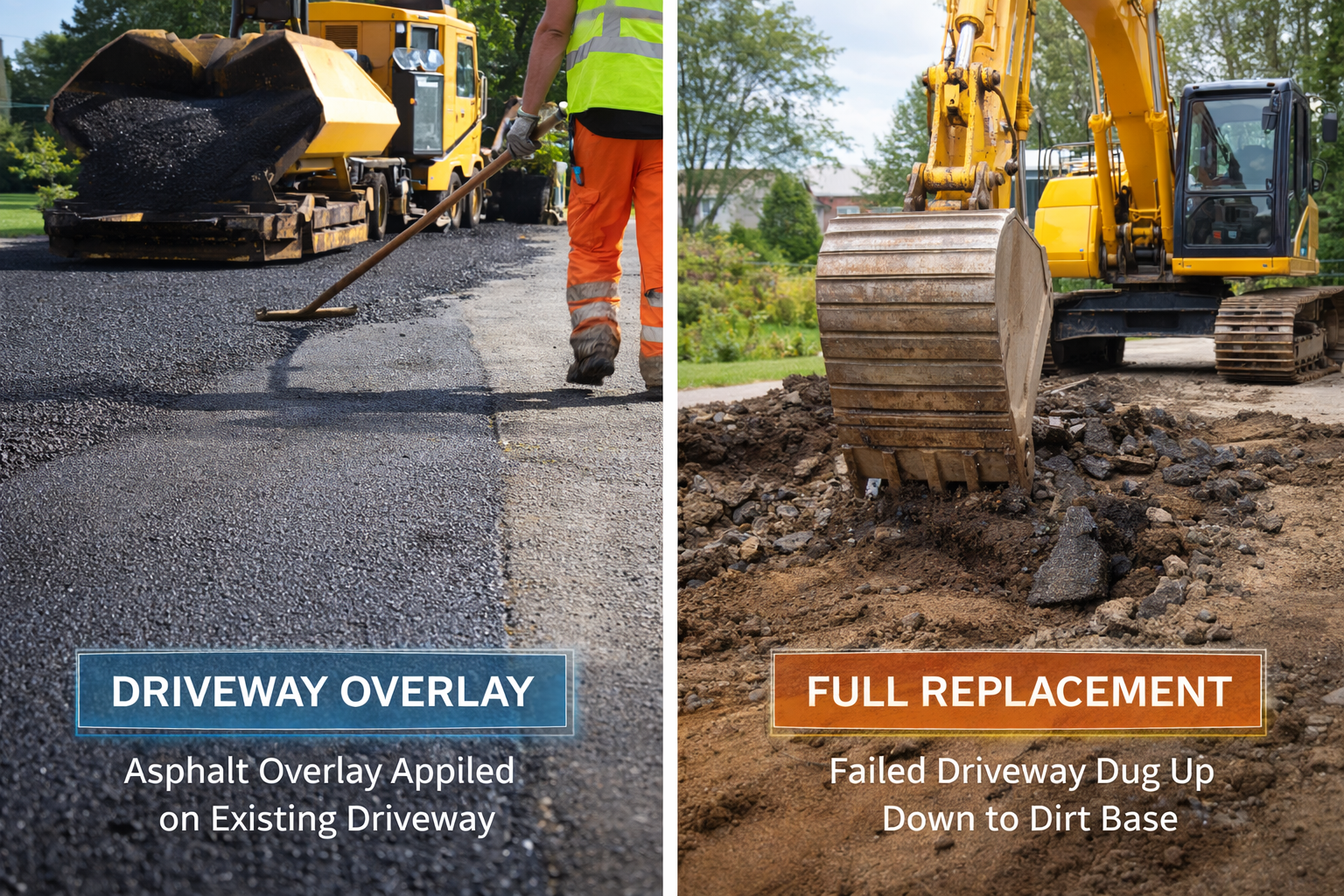
Many homeowners use the terms “asphalt resurfacing,” “overlay,” and “full reconstruction” interchangeably. From an engineering perspective, confusing these terms leads to catastrophic financial mistakes.
An overlay applies a new wearing course over existing pavement, while a full replacement involves complete excavation down to the subgrade. The correct decision does not depend on your budget; it relies entirely on the structural condition of the base layer. Choosing an overlay for a failing base will result in surface failure within just a few years.
For a comprehensive understanding of pavement layers, refer to our Residential Asphalt Paving Guide and explore The Master Paving Guide.
Average Cost: Asphalt Overlay vs Full Replacement
The cost delta between an overlay and a replacement is massive. Below are the 2026 engineered estimates for standard residential repair methods.
| Repair Method | Cost per Sq. Ft. | Typical 800 Sq. Ft. Driveway |
|---|---|---|
| Asphalt Overlay | $3.50 – $6.00 | $2,800 – $4,800 |
| Milling + Overlay | $4.50 – $7.50 | $3,600 – $6,000 |
| Full Replacement | $8.00 – $15.00 | $6,400 – $12,000 |
The significant price difference stems from heavy excavation, aggregate base reconstruction, asphalt disposal fees, and double the material quantity. To understand overall market averages, see our breakdown on How Much Does Paving a Driveway Cost.
What Is an Asphalt Overlay?
An overlay (or resurfacing) is the process of applying a fresh layer of hot mix asphalt directly over the existing pavement.
Technically, this requires routing and crack repair, the application of a binding tack coat (SS-1h), and surface leveling. The new compacted layer is typically 1.5 to 2 inches thick. Verify your structural load requirements using our Asphalt Thickness Calculator Guide.
Overlay Checklist:
- ✔ Edge Milling (Transitions)
- ✔ Deep Crack Filling
- ✔ Tack Coat Adhesion Layer
- ✔ 2-Inch Surface Lift
When an Asphalt Overlay Is the Right Solution
An overlay is a highly effective, cost-saving repair method, but only when specific geotechnical criteria are met:
- 1. The Base Layer is Stable: No bouncing or subgrade shifting.
- 2. Superficial Cracks: Cracks are narrow and non-structural.
- 3. No Structural Rutting: The surface has not sunk in the wheel paths.
- 4. Functional Drainage: Adding 2 inches will not reverse water flow toward the house.
* Note that regional climates drastically affect base stability. See our localized cost data for Florida , California , and Texas to understand how heat and soil plasticity impact your overlay options.
When Full Replacement Is Required
Installing a 2-inch overlay over a failed aggregate base is a cosmetic repair that will reflect cracks almost immediately. A full excavation and replacement is mandatory when you observe:
-
⚠️
Alligator Cracking: Interlocking, web-like cracks signaling complete base fatigue.
-
⚠️
Base Failure & Pumping: Mud and water squeezing up through surface cracks under pressure.
-
⚠️
Severe Rutting: Deep depressions indicating subgrade collapse.
-
⚠️
Drainage Collapse: Water pooling against the foundation requiring a total re-grading.
For proper structural reconstruction standards, review the Residential Asphalt Paving Guide.
Engineering Thickness Standards
A standard new driveway structure utilizes a 6–8 inch aggregate base supporting a 3-inch compacted asphalt surface.
Conversely, an overlay structure relies on the existing pavement to act as the base, requiring only a 1.5 to 2.0 inch asphalt layer. Ensure your contractor calculates the correct material volume to achieve this compacted depth. Read our guides on How Do I Calculate How Much Asphalt I Need and the Asphalt Tonnage Calculator Formula Guide for precise math.
Case Study: Overlay vs Replacement Decision
Residential Driveway Inspection
- Location: Suburban residential area
- Driveway Size: 780 sq. ft.
- Inspection Results: Moderate surface cracking, base remained stable, proper drainage slope intact.
The Implemented Solution
- Mill 1 inch at transitions.
- Apply SS-1h tack coat.
- Install 2-inch compacted overlay.
Engineer’s Conclusion: The overlay was highly successful solely because the underlying base layer remained structurally sound.
Lifespan Comparison
| Repair Type | Expected Lifespan |
|---|---|
| Asphalt Overlay | 10 – 15 years |
| Full Replacement | 20 – 30 years |
These lifespans are variable and depend heavily on climate, daily traffic volume, and adherence to preventative maintenance. To maximize longevity, review our Asphalt Sealcoating Cost Spray vs Squeegee guide.
How to Estimate Overlay Cost
Before requesting quotes, follow these practical steps to estimate your project parameters:
- Measure Driveway Square Footage: Calculate length by width.
- Determine Overlay Thickness: Aim for 1.5 to 2 inches compacted.
- Calculate Asphalt Tonnage: Use density formulas to find total weight.
- Add Milling Cost: Factor in grinding at the garage and street joints.
- Include Labor and Equipment: Mobilization and vibratory rollers.
To streamline step 3, utilize the Asphalt Tonnage Calculator Formula Guide or read How Do I Calculate How Much Asphalt I Need.