
Asphalt Driveway Cost in California:
The Engineer’s 2026 Price Guide
Why is paving so expensive in the Golden State? We break down the real costs ($9.00 – $16.00/sq ft), CARB regulations, and the seismic advantage of asphalt.
If you are planning to pave a driveway in California in 2026, you must throw the “national average” out the window. Between the Bay Area, Los Angeles, and the Sierra Nevadas, California represents the most complex—and expensive—paving market in the United States.
As a civil engineer, I constantly field calls from homeowners shocked by their estimates. Why does it cost $10,000 to $15,000 to pave a standard residential driveway in California? The answer lies in strict environmental mandates (CARB), high labor wages, and the unique geotechnical requirement for seismic flexibility.
1. The 2026 California Cost Matrix
Material (Hot Mix) costs at the plant are currently hovering between $120 and $160 per ton in CA. When combined with prevailing wage labor and high transportation costs, here is what you can expect to pay per square foot (installed):
| Project Type | Cost per Sq. Ft. | Engineering Note |
|---|---|---|
| Basic Overlay (Resurface) | $4.50 – $7.00 | Only viable if existing base has zero seismic cracks. |
| Standard 3″ New Install | $9.00 – $14.00 | Standard residential. Includes 4-6″ Class 2 Aggregate Base. |
| Heavy Duty / Hillside | $14.00 – $20.00+ | Required for steep grades (e.g., Hollywood Hills) & heavy retaining. |
2. The “California Premium” Explained
Why is paving $3-$5 more per square foot here than in Texas or Florida? It comes down to three inescapable factors:
CARB Regulations
The California Air Resources Board (CARB) mandated that all older diesel dump trucks be phased out. Paving contractors had to buy entirely new fleets by 2025/2026. That massive capital cost is passed directly to the consumer.
Labor & Insurance
California has the highest Workers’ Compensation rates for construction in the country. A legitimate, licensed contractor must charge more simply to cover liability and prevailing wages.
Environmental Fees
Asphalt plants face heavy emissions taxes. Additionally, many CA municipalities now require the use of Warm Mix Asphalt (WMA) to reduce greenhouse gases during paving, which alters production costs.
3. Seismic Activity: Why Asphalt Beats Concrete in CA
If you live near the San Andreas or Hayward faults, you feel micro-tremors regularly.
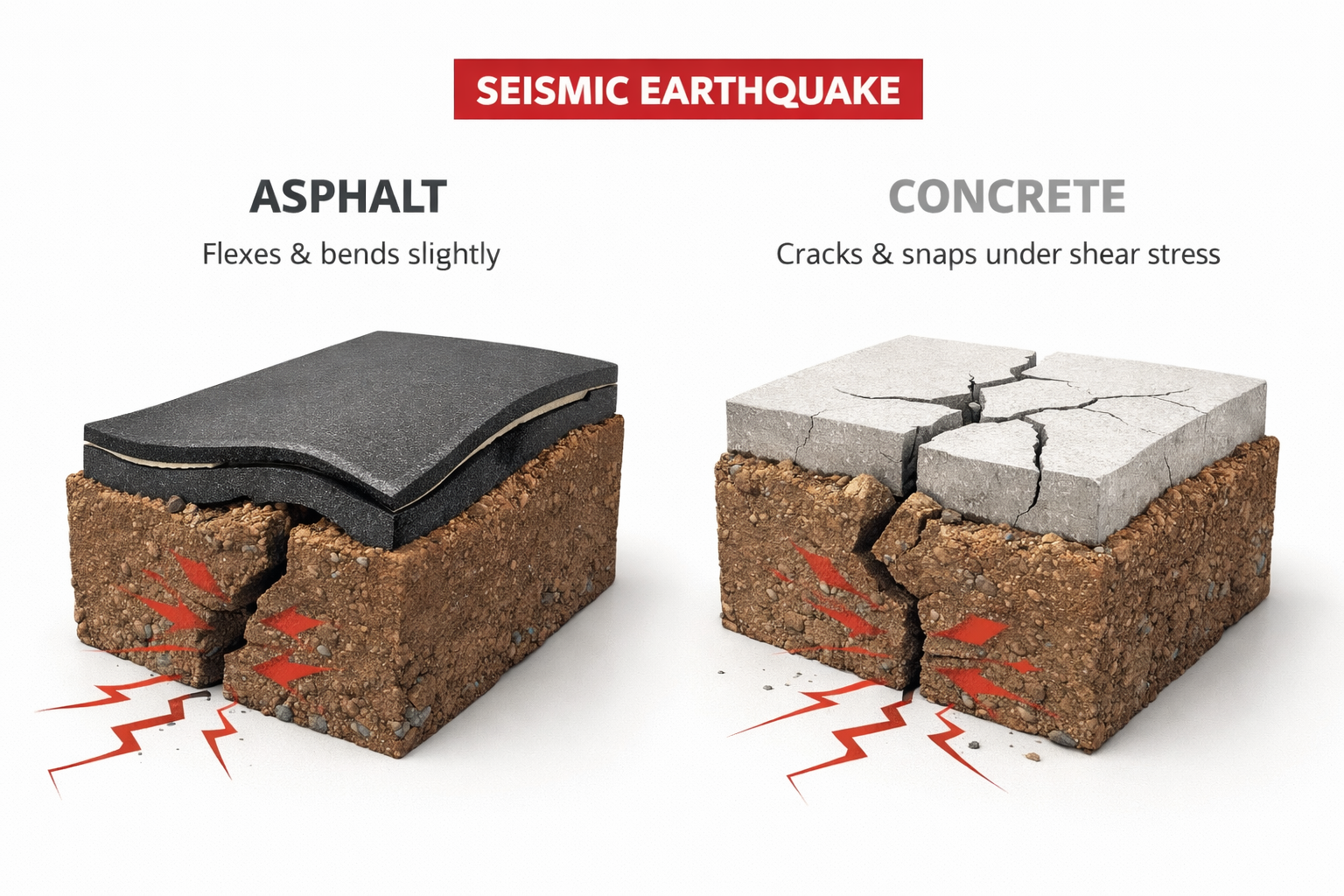
Concrete is a rigid material. When the earth shears, concrete snaps, creating massive, unrepairable cracks.
Asphalt is a viscoelastic material. It is literally a highly viscous liquid at its core. When the earth moves, asphalt flexes. If a tremor does cause a crack, asphalt can be easily melted and sealed with hot rubber. For seismic zones, Asphalt is the superior structural choice.
4. Pricing by California Region
🌉 San Francisco / Bay Area
Highest labor rates, strict CEQA permitting, steep grades.
🌴 Los Angeles / San Diego
High competition lowers cost slightly, but Urban Heat Island rules apply.
🌵 Central Valley / Palm Springs
Flatter terrain, lower labor, but requires high-temp binder (PG 70-10).
California Paving FAQs
What is the “Cool Pavement” mandate in Los Angeles? ▼
Do I need a permit to pave my driveway in California? ▼
How thick should my driveway be in California? ▼
📚 Expand Your Research
Get Your Exact Tonnage Estimate
Don’t let high California prices blindside you. Enter your exact length, width, and desired thickness to know exactly how many tons of material you are paying for.
START CA CALCULATOR