
How to Calculate How Much Asphalt You Need:
The 2026 Engineer’s Formula
Stop guessing. Most online calculators are wrong because they ignore “Compaction Factors.” Here is the precise formula to determine tonnage for any shape.
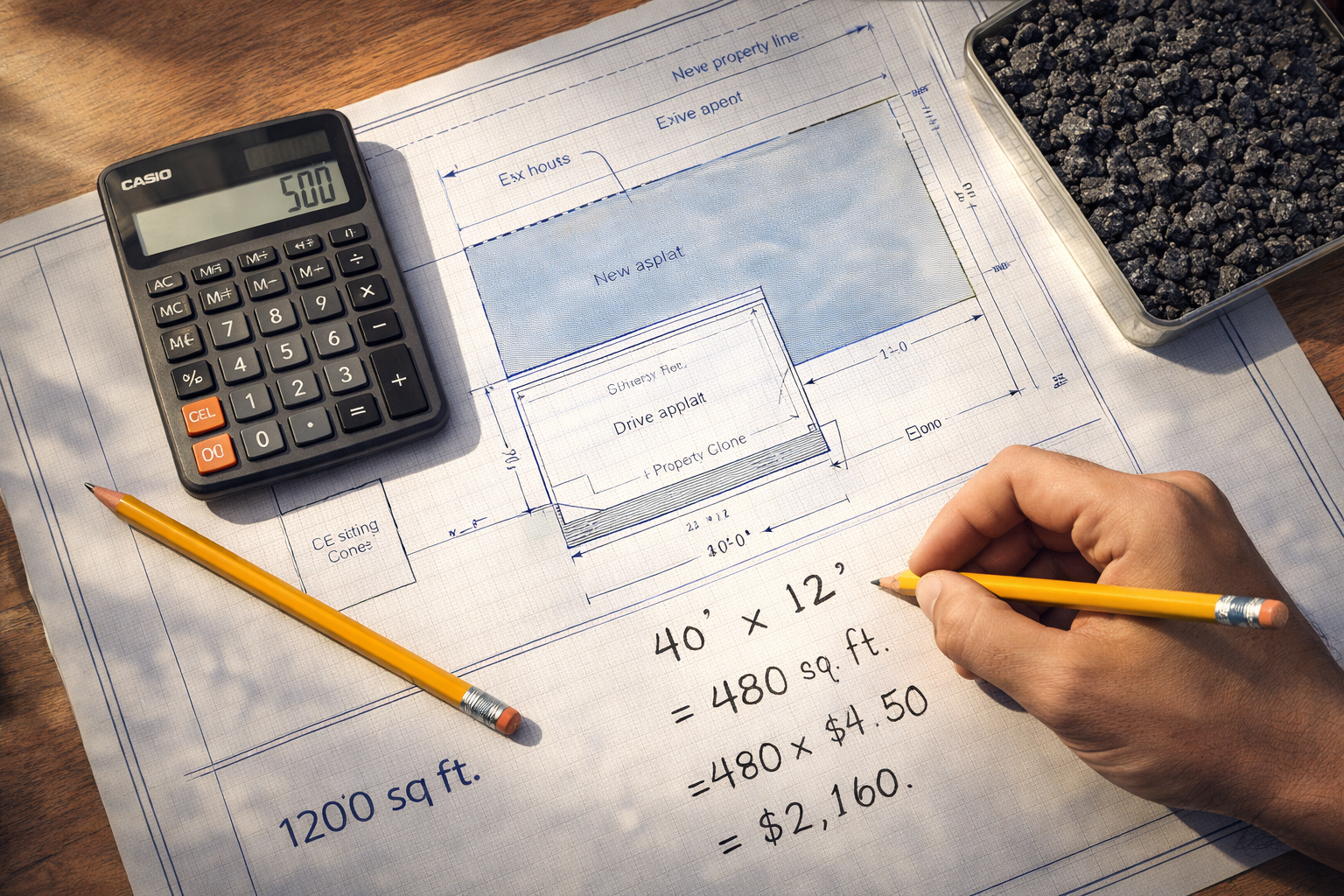
Here is the nightmare scenario: The paving crew is 90% done with your driveway. The truck tilts up… and it’s empty. You are 10 feet short.
Now, the crew has to leave, the asphalt cools, and you are left with a permanent “Cold Joint” (a seam that will crack in 2 years). Why does this happen? Because most people calculate simple volume ($L \times W \times H$) without accounting for the Physics of Compaction.
In this guide, we will move beyond basic math. We will apply the civil engineering standard used in 2026 to calculate Hot Mix Asphalt (HMA) tonnage with precision.
The Magic Number: 148
Asphalt is sold by the Ton, not by the yard. To convert volume to weight, you must know the density. Standard surface mix (wearing course) has a density of approximately 148 lbs per cubic foot.
⚠️ The “Fluff Factor”: Loose vs. Compacted
Do Not Order “Finished” Thickness!
Asphalt contains air voids. When you run a roller over it, it shrinks by 20% to 25%. If you want a 3-inch finished driveway, you cannot order 3 inches of material. You must order 4 inches.
The 1.35 Multiplier
Engineers multiply finished depth by 1.35 to determine loose depth.
Not sure how thick you need?
Is 3 inches enough? Or do you need 4 inches for an RV? A thin driveway will crack in winter.
Read our Structural Thickness GuideHow to Measure Complex Shapes
Driveways are rarely perfect rectangles. Here is how a Civil Engineer breaks down complex geometries (Triangulation).
Circular Area
Measure from the center point to the edge (radius). Square it, then multiply by 3.14.
Triangular Area
Use this for the flared entry where the driveway meets the street.
Quick Reference: Tons Required
Based on 3-Inch Compacted Thickness (Standard Residential). Includes 5% safety waste factor.
| Driveway Size | Square Footage | Est. Tonnage | Est. Material Cost (2026) |
|---|---|---|---|
| 1 Car (Short) | 200 sq. ft. | 3.8 Tons | ~$400 |
| 2 Car (Standard) | 600 sq. ft. | 11.5 Tons | ~$1,200 |
| Long Country Drive | 1,500 sq. ft. | 28.5 Tons | ~$3,000 |
* Material cost only ($100/ton). Does not include labor/grading. See Full Cost Guide.
More Calculation Tools
Skip the Math. Use the Tool.
Our algorithm automatically applies the 148 density constant and the 5% waste factor. Just enter your dimensions.
CALCULATE MY TONNAGE