
The Master Guide to Residential Asphalt Projects:
Measuring, Pricing, and Paving (2026)
A technical manual for homeowners and contractors. We dissect the physics, thermodynamics, and unit economics of a 20-year pavement system.
1. Executive Engineering Summary: The 2026 Pavement Reality
In the discipline of civil engineering and construction estimation, the residential driveway is frequently—and erroneously—classified as a mere cosmetic feature of the landscape. As a Senior Civil Engineer with two decades of field experience, I define it differently: a residential driveway is a structural load-bearing platform that must withstand hydrostatic pressure, thermal cycling, and dynamic vehicular loads. It is a piece of transportation infrastructure, subject to the same laws of physics and material science as a municipal roadway.
Entering 2026, the pavement market has shifted significantly. The era of “cheap blacktop” is functionally over, driven by volatility in global crude oil markets which directly dictate liquid asphalt cement (AC) binder prices. Current terminal prices for AC have stabilized around $542.50 to $569.00 per ton, a raw material cost that cascades down to the hot mix plant and, ultimately, the homeowner. This price floor establishes a new baseline for residential project estimation, necessitating a rigorous approach to budgeting and design.
For the residential stakeholder or contractor, the financial reality of 2026 is strict. A standard 600-square-foot driveway now commands a national average installation cost of $5,265, with a typical range between $3,130 and $7,403 depending on geotechnical conditions and regional labor rates. We are seeing installed unit prices fluctuating between $7.00 and $15.00 per square foot for full replacement.
The engineering problem is clear: Asphalt is a viscoelastic material. It behaves as an elastic solid at low temperatures and a viscous liquid at high temperatures. Failure to respect the thermodynamics of installation, the physics of compaction, or the hydrology of drainage will result in structural failure within 3 to 5 years. This report serves as a technical manual to navigate these variables, ensuring a pavement lifespan that exceeds 20 years. It is designed for those who require definitive data over estimation guesswork.
2026 Residential Cost Matrix & Engineering Standards
Before breaking ground, one must understand the unit economics. The following table synthesizes current 2026 market data, derived from terminal indexes and contractor aggregate pricing. These figures represent the “Engineer’s Estimate”—the baseline against which all contractor bids should be measured.
| Line Item | Unit | Low Range (2026) | High Range (2026) | Engineering Note |
|---|---|---|---|---|
| New Install (Raw Land) | Per Sq. Ft. | $7.00 | $13.00 | Includes excavation & 6-8″ aggregate base. |
| R&R (Remove & Replace) | Per Sq. Ft. | $8.00 | $15.00 | Includes haul-away of millings/debris. |
| Overlay (Resurface) | Per Sq. Ft. | $3.00 | $7.00 | High risk if underlying cracks are not treated. |
| Recycled Millings | Per Sq. Ft. | $6.00 | $9.00 | Lower cohesion; prone to raveling. |
| Hot Mix Asphalt Material | Per Ton | $100.00 | $150.00 | Plant price only (FOB). |
| Labor Rate | Per Sq. Ft. | $5.00 | $7.00 | Crew overhead, mobilization, & profit. |
| Sealcoating (Pro) | Per Sq. Ft. | $3.00 | $7.00 | Required every 3-5 years. |
2. Estimator’s Insight: The Geotechnical Foundation
A driveway is only as strong as the earth beneath it. In civil engineering, we view the asphalt surface merely as a “wearing course”—a roof built over a structural foundation. If the foundation shifts, the roof cracks. This section dissects the mechanics of the sub-grade, the element of the project that is most often neglected and the primary cause of catastrophic pavement failure.
2.1 Soil Mechanics and Sub-Grade Stabilization
The most critical phase of construction occurs before a single ounce of hot mix is poured. It begins with the sub-grade—the native soil. The structural integrity of the pavement system relies entirely on the sub-grade’s ability to support load distribution without excessive plastic deformation.
The California Bearing Ratio (CBR)
Technically, the sub-grade must possess sufficient bearing capacity. In residential applications, we look for stable, non-plastic soils. Clay-heavy soils (expansive soils) are the enemy of asphalt. They swell when wet and shrink when dry. When evaluating a site, an engineer considers the Plasticity Index (PI). If the native soil is poor (CBR < 5), it must be amended via "undercutting" or chemical stabilization.
The Proof Roll Protocol
How do you verify sub-grade stability without a laboratory? You perform a Proof Roll.
- Procedure: A fully loaded tandem-axle dump truck (20-25 tons) is driven slowly over the sub-grade.
- Pass Criteria: No visible movement or deflection less than ½ inch.
- Fail Criteria: The ground “waves” or ruts > 1 inch. This indicates a soft spot that must be undercut.
2.2 The Aggregate Base Specification
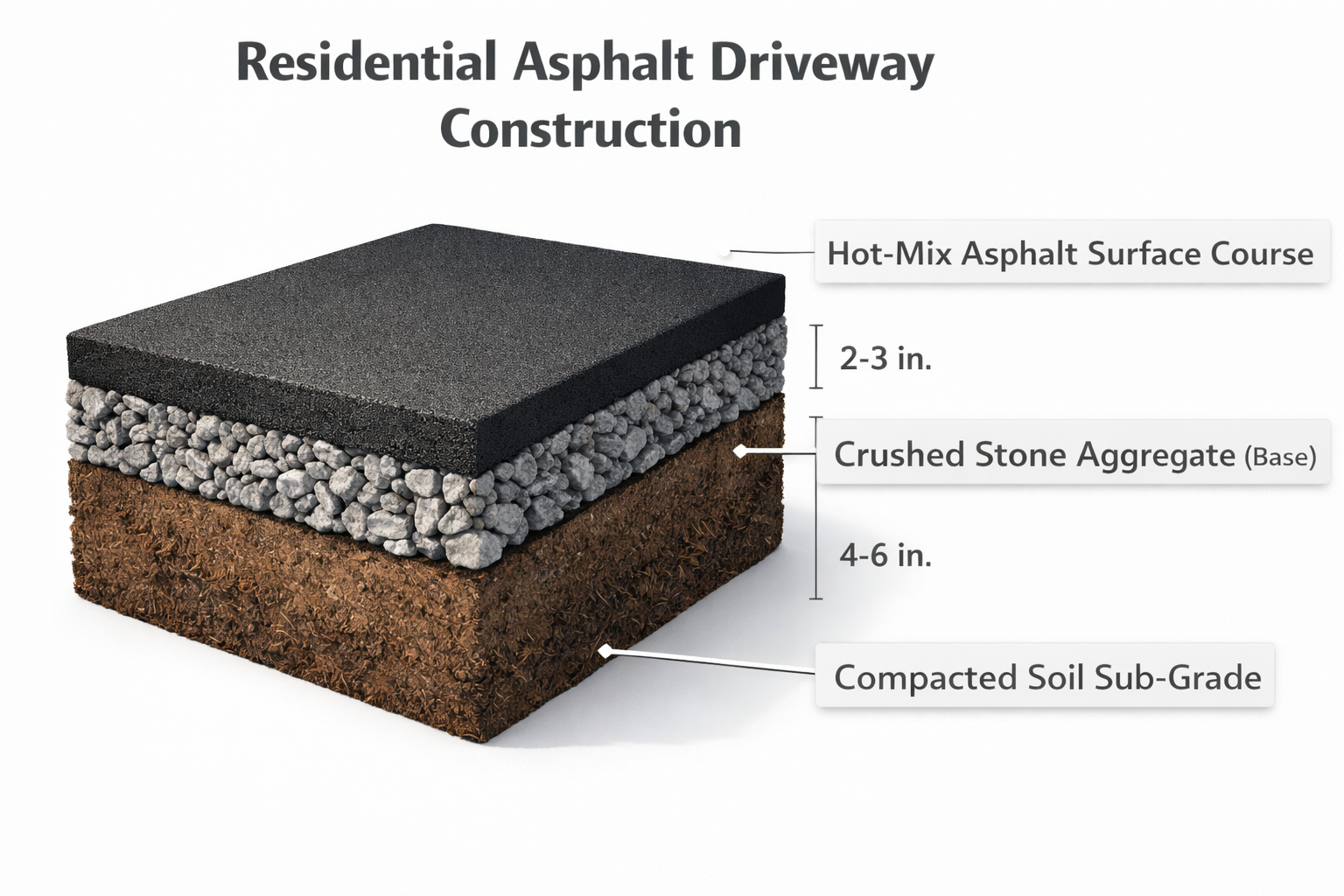
Do not compromise on the aggregate base. For 2026 standards, I specify a minimum compacted thickness of 6 to 8 inches of crushed aggregate. This layer performs two functions: Load Transfer (distributing weight) and Capillary Break (preventing water wicking).
The cost of a proper base is significantly lower than the cost of premature failure. For a detailed comparison of base materials, see our Gravel & Base Guide.
3. Hydraulic Engineering: Drainage and Slope Analysis
Water is the universal solvent and the primary cause of asphalt failure. When water penetrates the sub-base, it reduces the soil’s shear strength and, in freeze-thaw climates, expands by 9% upon freezing, heaving the pavement.
3.1 The 2% Rule and Slope Geometry
-
✓
Minimum Slope: 1.5% to 2% is the industry standard (approx. ¼ inch drop per foot).
-
✓
Crown vs. Cross-Slope: For long driveways, center crowning sheds water to edges. For driveways near structures, grade must fall away from the foundation.
3.2 Hydraulic Structures: Pipes and Swales
If the driveway crosses a drainage ditch, the side drain pipe must be sized to handle the flow rate (Q). A minimum diameter of 15-18 inches is required, with at least 12 inches of compacted cover to prevent crushing.
4. Material Science: The Mix Design
“Asphalt” is actually a composite material properly termed Hot Mix Asphalt (HMA).
4.1 Binder Grades (PG)
The glue. A typical residential mix uses PG 64-22.
64: Max temp (°C) before rutting.
-22: Min temp (°C) before cracking.
4.2 Aggregate Gradation
Binder Course: Larger stone (19mm) for strength.
Surface Course: Smaller stone (9.5mm) for smooth finish.
4.3 Recycled Asphalt Pavement (RAP)
The 2026 market sees heavy use of Recycled Asphalt Pavement (RAP). While eco-friendly and cheaper, high RAP percentages can make the mix brittle.
Engineer’s Recommendation: Limit RAP content to 20% for surface courses. For more on recycled materials, review our Recycled Millings Guide.
5. Structural Design: Thickness Engineering
How thick should it be? This depends on traffic load (ESALs). For most residential applications, the 3-Inch Standard (compacted) applies.
| Design Type | Aggregate | Asphalt | Cost Factor |
|---|---|---|---|
| Economy | 4-6 inches | 2 inches | $ |
| Standard | 6-8 inches | 3 inches | $$ |
| Heavy Duty | 8-10 inches | 4 inches | $$$ |
For a comparison against other materials, see our Pavers vs. Asphalt vs. Concrete Guide.
6. Operational Execution: The Paving Process
6.1 Thermodynamics: The Temperature Window
Asphalt is a thermoplastic.
Arrival: Must be 275°F – 300°F.
Cessation Point: Compaction MUST be completed before the mix drops below 175°F. Below this, rolling fractures the aggregate. If a contractor arrives with “cold” asphalt (<220°F), reject the load.
6.2 Compaction & 6.3 Tack Coat
We target 92% to 98% density. Too many air voids (>8%) allows water infiltration.
Tack Coat: When overlaying, liquid asphalt emulsion (SS-1h) is non-negotiable. Without it, the layers delaminate like a rug on a hardwood floor.
7. Deep Dive: Measuring & Tonnage Calculation
Accurate estimation prevents material shortages (cold joints) and overages (wasted budget).
7.2 The Tonnage Formula
The 110 Rule: A simplified rule is 110 lbs per square yard per inch of thickness.
Example (1,000 sq ft, 3″ thick): Requires ~18.75 tons. Always add 5% waste.
8. Financial Case Study: The 10-Year ROI
To demonstrate the true cost of ownership, let us analyze two scenarios for a standard 1,000 sq. ft. driveway (2026–2036).
Scenario A: The “Low Bid”
- • Year 0: $3,500 (2 inches, minimal prep)
- • Year 2: Edge cracking ($100)
- • Year 4: Alligator cracking/Potholes ($800)
- • Year 7: TOTAL FAILURE (Replacement: $6,000)
Scenario B: Engineered
- • Year 0: $6,500 (6″ Base + 3″ HMA)
- • Year 3: Sealcoating ($400)
- • Year 6: Sealcoating ($450)
- • Year 10: Structurally Sound
9. Pro Tips: Engineer’s Advice
9.1 The Thickness Trap: Loose vs. Compacted
A dishonest contractor promises “3 inches.” You must clarify: “Loose or Compacted?”
Asphalt compacts by ~25%. To get 3″ compacted, you must lay 4″ loose.
9.2 The “Yield” Verification
As the homeowner, you can verify yield. Ask for the weigh tickets from the plant. Sum the tonnage and compare it to your calculation. If the math says 20 tons and tickets say 15, you were shorted.
10. Take Control of Your Estimate
In 2026, a driveway is a capital improvement. Do not leave the variables to chance. Stop guessing and verify your contractor’s numbers using the 110-lb yield rule.
USE FREE PAVING CALCULATORGenerates precise 2026 Material & Cost Estimates