
Paver Patio Cost & Sand Calculation Guide (2026)
Stop guessing. Learn how to calculate the exact number of bricks, bedding sand, and polymeric joint sand to prevent sinking.
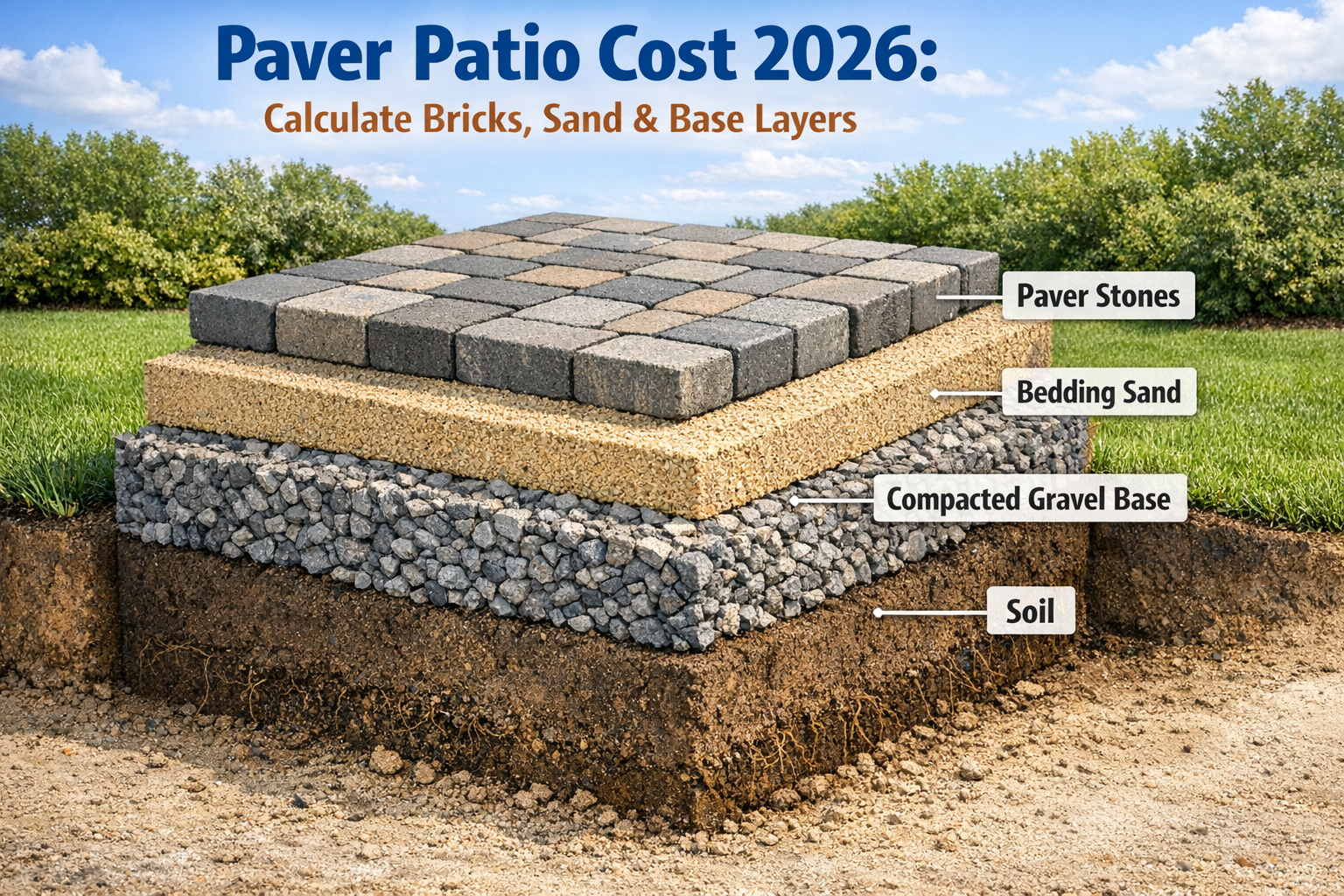
A paver patio isn’t just a collection of bricks; it’s a flexible pavement system. The #1 reason DIY patios fail within 2 years is incorrect base calculation.
If you calculate only the square footage of the bricks, you will fail. You must calculate the tonnage of the base gravel and the volume of the bedding sand. Below, we break down the 2026 costs and the math behind a zero-sink installation.
2026 Material Costs
UPDATED: FEB 2026Concrete Pavers
Standard & Durable
Clay Brick
Classic Aesthetic
Natural Stone
Flagstone / Slate
Don’t forget the “Invisible” Cost: The base materials (Gravel & Sand) typically account for 20-30% of the total project budget. Ignoring this leads to budget overruns.
The Sand Calculation Formula
1 Bedding Sand
This is the layer directly under the bricks. It acts as a cushion to level the pavers.
- Depth: Strictly 1 inch (max).
- Type: Coarse concrete sand (washed).
- Risk: Too thick (>1.5″) causing “rutting.”
2 Polymeric Sand
The glue that holds pavers together. It activates with water to lock the joints.
- Coverage: Varies by paver shape.
- Standard: ~1 bag (50lbs) per 50-75 sq.ft.
- Risk: Installing on wet pavers (causes haze).
Pro Estimator Rule: The “Cut Waste” Factor
When ordering pavers, never order the exact square footage. You will cut bricks to fit edges, creating unusable scrap.
Our Calculator Automatically Adds:
Safety MarginsCalculate Bricks & Sand Instantly
Input your patio dimensions to get the total number of pavers, tons of sand, and base gravel required.
Open Paver Calculator