
Cost to Repave an Existing Asphalt Driveway:
The 2026 Engineer’s Guide
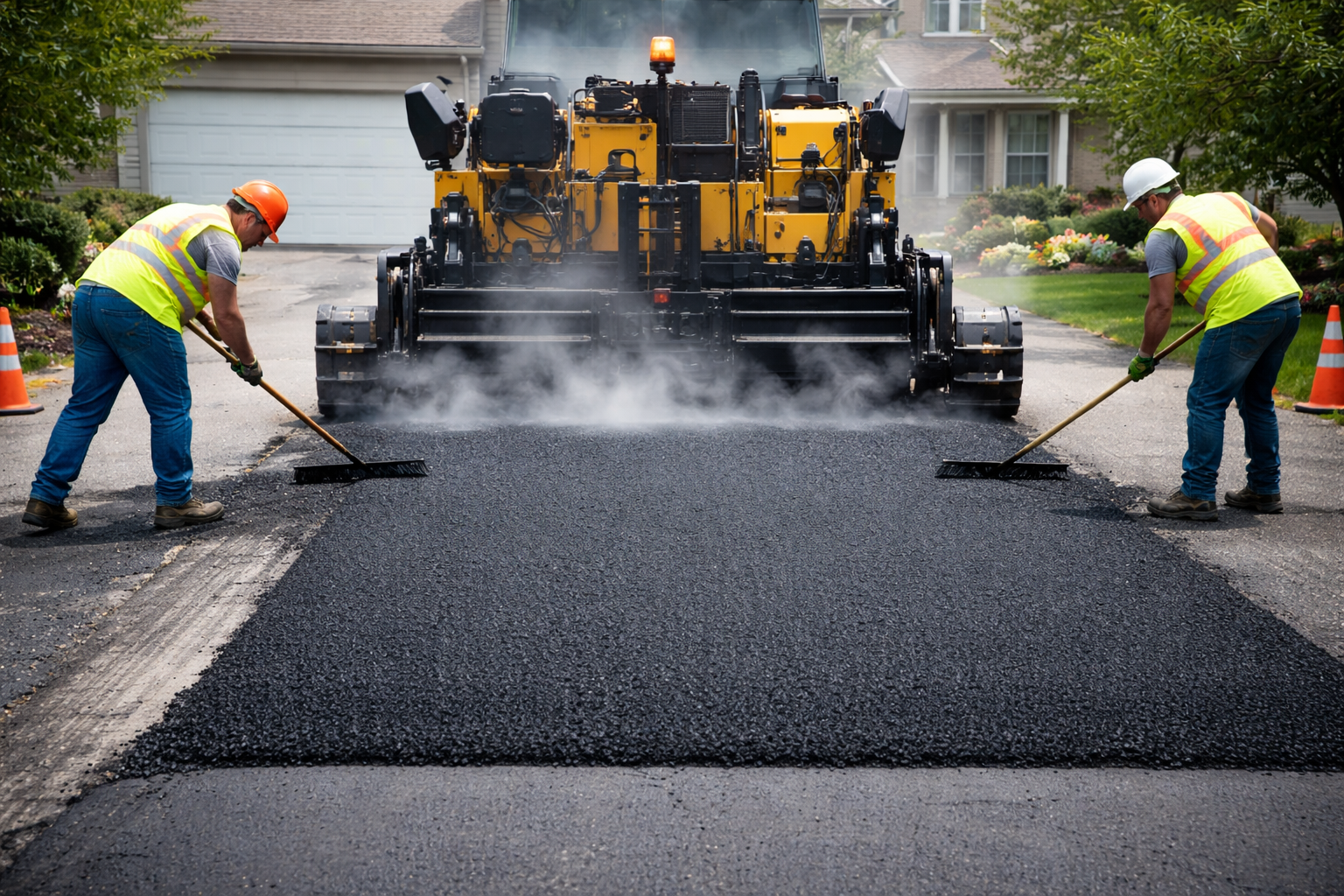
In civil engineering, repaving an asphalt driveway is rarely a question of square footage alone; it is a question of structural integrity.
Homeowners often confuse a cosmetic overlay (resurfacing) with a full replacement. An overlay involves paving a new layer of hot mix asphalt directly over the existing surface. A full replacement requires excavating the failed pavement down to the aggregate base. The final cost depends entirely on the geotechnical stability of what lies beneath.
Climate also dictates the method. An overlay that survives a mild winter may shatter under the expansive clay of Texas or fail to meet the seismic compliance required in California.
Average Cost to Repave an Asphalt Driveway
Repaving costs in 2026 are driven by liquid asphalt binder indexes and required preparation. The table below outlines the true installed cost for standard residential projects.
| Repaving Type | Cost per Sq. Ft. | 600–1,000 Sq. Ft. Driveway |
|---|---|---|
| Basic Overlay (2”) | $3.50 – $5.50 | $2,100 – $5,500 |
| Milling + Overlay | $4.50 – $7.50 | $2,700 – $7,500 |
| Structural Repairs + Overlay | $6.00 – $9.00 | $3,600 – $9,000 |
Engineer’s Breakdown: This pricing includes material cost per ton, labor, edge milling, application of the SS-1h tack coat (the bonding glue), and mandatory vibratory compaction passes. Do not accept bids that omit the tack coat; the new layer will delaminate.
Overlay vs. Full Replacement (The Critical Decision)
Choosing to repave (overlay) a failed foundation is equivalent to painting a rotten piece of wood. It is a cosmetic illusion that will reflect cracks within a year.
| Factor | Overlay (Resurfacing) | Full Replacement |
|---|---|---|
| Cost | Lower ($3.50+) | Higher ($7.00+) |
| Lifespan | 8 – 15 years | 15 – 25 years |
| Required Condition | Stable Base, Minor Surface Cracks | Failed Base, Deep Ruts |
If your driveway exhibits alligator cracking (interlocking web-like cracks), subgrade pumping (mud squeezing through cracks), or severe edge failure, an overlay is mathematically unjustifiable. You must refer to our Residential Asphalt Paving Guide for full replacement protocols.
What Determines Repaving Cost?
Existing Asphalt Condition
The severity of existing cracks dictates prep work. Deep rut depth requires leveling courses (extra tonnage). High oxidation levels (grey, brittle asphalt) require heavier tack coat application to ensure adhesion.
Milling Requirements
If the driveway meets a garage floor or a sidewalk, paving 2 inches on top will create a tripping hazard and block drainage. Edge milling (grinding down the transition zones) is required, adding $1.00 – $2.00 per sq ft to the affected area.
Driveway Size & Access
If a tri-axle dump truck cannot back into your driveway due to tree canopies or narrow gates, the asphalt must be transported via skid steer. This decreases production rates and increases labor costs.
Local Material Pricing
Per-ton costs vary wildly by state due to aggregate availability and oil terminal proximity.
Engineering Thickness Standards for Repaving
A 1-inch overlay is a temporary band-aid that cools too fast during installation, preventing proper density. The engineering standard for a residential overlay is a 1.5” to 2” compacted surface lift.
Remember the compaction factor: To achieve 2 inches of load-bearing capacity, the paver must lay approximately 2.5 inches of loose mix. The underlying base must possess minimum stability to provide a hard “anvil” for the vibratory roller to compress the new mix against. For a deep dive into load capacity, consult our Asphalt Thickness Guide.
Case Study: 850 Sq Ft Residential Repave
The Engineered Solution:
- Mill 1.5” at garage and street transitions.
- Apply commercial-grade SS-1h tack coat.
- Install 2” surface lift (compacted).
Results After 18 Months:
- Zero reflective cracking from the old layer.
- Perfect edge stability.
Why it worked: The existing base was structurally intact, the drainage slope was maintained, and proper thermal compaction was achieved.
When Repaving Is NOT Recommended
An ethical estimator will walk away from an overlay if they observe:
- ✘ Structural Failure: Massive interlocking cracks indicating a collapsed base.
- ✘ Soft Subgrade: The driveway bounces or flexes under the weight of a truck.
- ✘ Deep Rutting: Water pools in wheel paths over 1.5 inches deep.
- ✘ Drainage Collapse: Water flows toward the house foundation instead of the street.
Engineer’s Verdict: In these scenarios, complete excavation is mandatory.
How to Calculate Repaving Cost Accurately
Do not rely on rough square footage estimates. Use this step-by-step engineering method:
- Measure Square Footage: Length × Width of the driveway.
- Determine Overlay Thickness: Standard is 2 inches compacted.
- Convert Volume to Tons: Apply the 145 lbs/ft³ density constant.
- Multiply by Regional Material Cost: Find the FOB plant price per ton.
- Add Labor & Milling: Factor in contractor overhead and equipment.
How Long Does a Repaved Asphalt Driveway Last?
A properly executed overlay yields a 10–15 year lifespan on average. This longevity depends heavily on local climate, subsurface drainage, and traffic loads.
To maximize this lifespan, the repaved surface must receive its first sealcoating within 12-24 months of installation, followed by regular intervals.
ROI of Repaving vs Replacement
From a lifecycle analysis perspective, repaving offers immediate curb appeal and property value boosts for roughly 50% of the cost of a new install.
Cost-per-year breakdown: A $4,000 overlay lasting 12 years costs $333/year. A $8,000 replacement lasting 20 years costs $400/year. If the base is good, the ROI heavily favors the overlay.
Repaving FAQs
Is it cheaper to resurface or replace a driveway? ▼
How thick should an asphalt overlay be? ▼
Can you pave over cracked asphalt? ▼
How long before driving on new overlay? ▼
Written by the Chief Estimator
Asphalt Paving Specialist with over 20 years of field experience in residential and commercial surface systems. Dedicated to bringing civil engineering accuracy to homeowner estimates.
Ready to get your numbers right?
Calculate your repaving asphalt driveway cost now →